What Is Investment Risk? Understand It Before You Trade
Risk is an unavoidable part of investing. Learn the main types of risk, plus a simple example of how to calculate the risk size for each order.
This article was compiled automatically from the sources listed below
Before you think about how much you could earn, the first question an investor should ask is, "If I'm wrong, how much can I afford to lose?" Whether you trade Forex, gold or stocks, risk is part of every decision. This article explains what risk is, what types there are, and how to manage it at a basic level.
This content is general knowledge for educational purposes only. It is not advice to buy or sell any asset.
What Is Investment Risk?
Risk is the uncertainty that the outcome will differ from what you expected, including the chance of losing money. Risk doesn't mean something is "bad". It is the price you accept when you enter the market. No investment is completely free of risk. What you can do is understand it, measure it, and keep it at a level you can handle.
The Main Types of Risk to Know
1. Market Risk Prices can rise or fall at any time because of economic news, interest rates, political events, or the mood of most investors. No one can control these things.
2. Leverage Risk Leverage lets you open a large position with a small amount of money. But your profits and losses are magnified according to the size of the position, not the amount of money you put up.
3. Liquidity and Slippage Risk During big news events or very quiet markets, the price you actually get may differ from the price you clicked. This is called Slippage, and the Spread may also widen.
4. Currency Exchange Risk If you invest in an asset in another currency, such as foreign stocks or gold traded in US dollars, your returns in baht or kip may change with exchange rates.
5. Risk From Your Own Behavior Greed, fear, and the urge to win money back often lead people to break their own plans. This is a common cause of losses among beginners.
6. Service Provider Risk Check whether your trading provider is under reliable regulation, and make sure you clearly understand the terms for deposits, withdrawals, and closing positions.
Turn Risk Into a Number
Instead of trading on feelings, decide in advance what percentage of your capital you are willing to lose on each order. Many people use a range of about 1–2% per order, but the right number depends on each person's situation.
The basic formulas are:
- Amount you accept losing = capital × risk percentage
- Usable value per Pip = amount you accept losing ÷ Stop Loss distance (in Pips)
Calculation Example: EURUSD
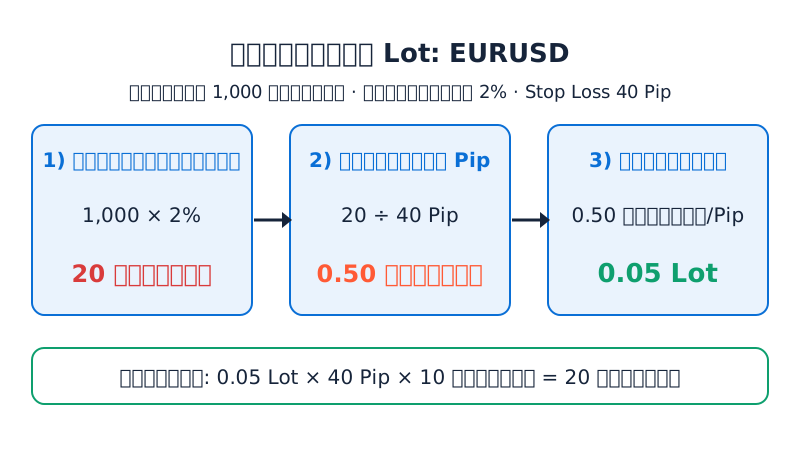
Suppose you have $1,000 in capital, set your risk at 2% per order, and plan a Stop Loss 40 Pips from your entry point.
- Amount you accept losing = 1,000 × 2% = $20
- Usable value per Pip = 20 ÷ 40 = $0.50 per Pip
- For EURUSD, a 0.01 Lot (1,000 units) is worth about $0.10 per Pip, so $0.50 per Pip equals 0.05 Lot
Check: 0.05 Lot × 40 Pips × $10 (per Pip per 1 Lot) = $20, which matches the risk you set.
If the Stop Loss is hit, the loss will be about $20, or 2% of your capital (not counting Spread and Slippage, which may cause a small difference). If you want a wider Stop Loss of 80 Pips with the same $20 risk, you need to reduce the size to 0.025 Lot. This is adjusting your position size to the Stop Loss distance, not increasing your risk.
Example: How Leverage Magnifies the Impact
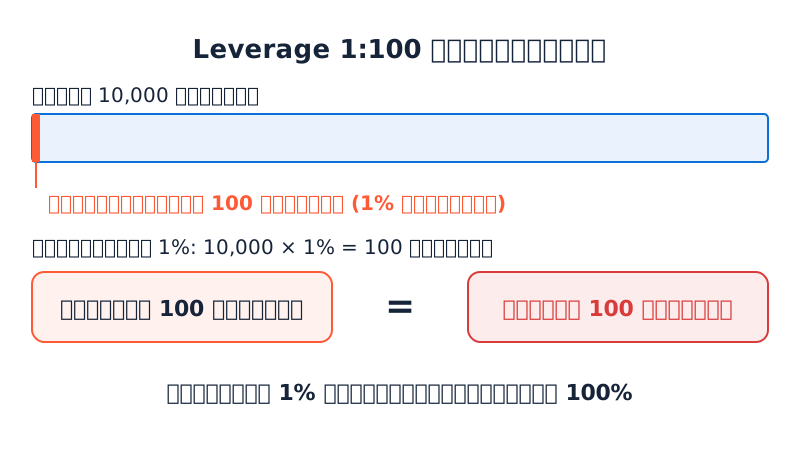
Suppose you use 1:100 Leverage to open a position worth $10,000, putting up $100 in margin.
- If the asset's price moves 1% against you, the loss = 10,000 × 1% = $100
- That equals all of the margin you put up
A price move of just 1% hits 100% of the money you put up. This is why high Leverage must be used with great care.
Why Big Losses Are Hard to Recover
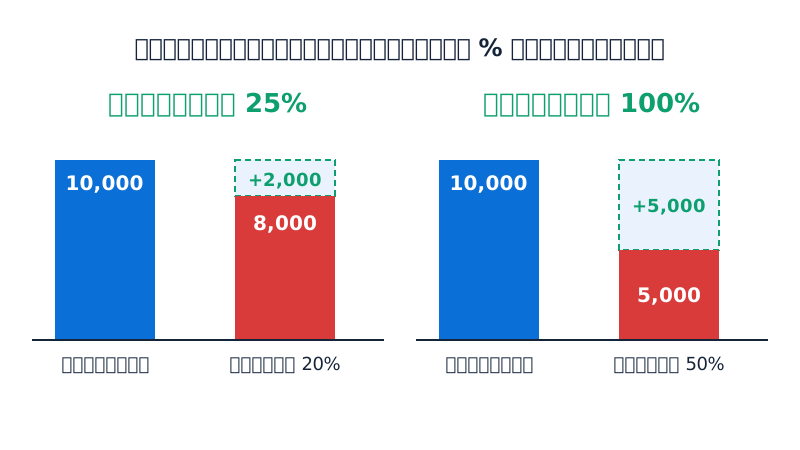
The percentage you lose and the percentage gain you need to get back to even are not the same number.
- With 10,000 in capital, a 20% loss leaves 8,000. You need a profit of 2,000 ÷ 8,000 = 25% to get back to where you started.
- With 10,000 in capital, a 50% loss leaves 5,000. You need a profit of 5,000 ÷ 5,000 = 100% to get back to where you started.
The deeper the loss, the harder it is to recover. That's why limiting the damage on each order matters more than trying to collect as much profit as possible.
Basic Ways to Manage Risk
- Use only spare money that won't affect your essential expenses or emergency savings.
- Decide your risk per order before every trade.
- Use a Stop Loss and place it according to your plan, not according to your feelings after the price has moved.
- Don't put too much money into assets or orders that tend to move in the same direction.
- Start with a demo account or a small amount of money so you can learn without getting hurt too much.
- Keep a trading journal to review whether you made mistakes because of your plan or because of emotions.
Common Beginner Mistakes
- Opening a Lot that's too big for your capital. You hope for quick profits, but even a small move against you causes heavy losses.
- Not setting a Stop Loss, or moving it further away. This turns a small loss into a big one.
- Increasing your size to win money back after a loss, which often leads to more losses.
- Following news or other people's advice without understanding it, and without a plan of your own.
- Thinking the risk is low because you won several times in a row, even though short-term results don't prove a method is always good.
- Not allowing for costs, such as Spread, fees, and Slippage.
Summary
Risk is part of investing and can never be eliminated, but you can manage it by understanding the types of risk, setting the amount of loss you can accept as a number, and using Leverage carefully. Nothing in the market is guaranteed. Setting a goal to "stay in the market for a long time" first will be a good foundation for your continued learning.
Ask the AI tutor about this lesson
Stuck on something? Ask and get a simple answer with examples.