Start With a Demo Account and a Simple Trading Plan
How long should beginners practice on a Demo account, and what should a trading plan include? Learn entries, exits and risk per trade, with a worked example.
This article was compiled automatically from the sources listed below

People who are new to trading often want to put in real money right away. But before you risk your own money, there is a free tool that lets you learn by trial and error without losing real funds: a Demo account. This article shows how to use a Demo account, what a simple trading plan should include, and when it makes sense to move to a live account.
What Is a Demo Account?
A Demo account uses virtual money. The prices you see are close to the real market, and you can buy and sell and watch your profit and loss just like in real trading. But the money you win or lose is only a made-up number.
A Demo account helps you:
- Learn the platform, such as placing orders, setting a Stop Loss and setting a Take Profit
- Understand how Lot, Pip and Spread affect your profit and loss
- Test your own trading plan before using real money
- Make mistakes without getting hurt
How Long Should You Practice on a Demo Account?
There is no single right answer for everyone, but a common guideline is about 2–3 months of consistent trading. It is better to measure this by the number of trades you have recorded rather than the number of days. For example, aim for at least 30–50 trades that truly follow your plan, because with only 5 trades, your results could just be luck.
While you practice, do these things too:
- Keep your Demo balance close to the amount you actually plan to trade with. For example, if you plan to start live with 500 USD, don't set your Demo balance to 100,000 USD.
- Follow the same plan the whole time. Don't switch methods every week.
- Record every trade: the date, the currency pair or asset, your reason for entering, your entry point, your exit point, the result, and how you felt at the time.
What Is a Trading Plan?
A trading plan is a set of rules written in advance, so you don't have to make decisions based on emotion while the price is moving. A good plan doesn't need to be complicated, but it should clearly answer these 5 questions.
1) What to Trade and When
Start with just a few assets, such as 1–2 (for example, EURUSD or XAUUSD). Decide which timeframe you will watch on the chart, and which hours of the day you can really focus on trading.
2) Entry Conditions
Write them as items you can check, not as feelings. Here are examples of the kinds of conditions you might use (for explanation only, not a recommendation):
- Price approaches a support or resistance level that you marked in advance
- A confirmation candle appears as you defined it
- No major news is scheduled within your chosen time window
If the conditions are not all met, don't enter.
3) Exit Conditions
You need an exit for a losing trade and an exit for a winning trade.
- Stop Loss: The price level where you accept that your analysis was wrong and exit immediately
- Take Profit: The target price level, which should be related to the size of your Stop Loss
Set both before you enter the trade, not after the price starts moving against you.
4) How Much to Risk Per Trade
A commonly taught rule is to limit the risk on each trade to a small percentage of your capital, such as 1%. Losing several trades in a row is normal. If you risk only a small amount per trade, your account can keep going.
5) Stop-Trading Rules
For example, stop for the day once your losses reach a set amount, or after a set number of losses in a row, take a break and review your records.
Example: Calculating Risk Per Trade
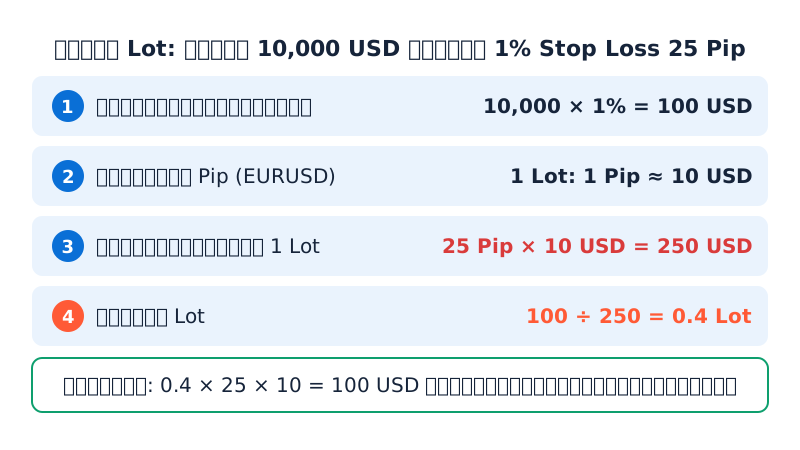
Suppose your Demo account has 10,000 USD and you set a rule to risk no more than 1% per trade. You trade EURUSD and plan a Stop Loss of 25 Pip.
Step 1: Find the amount you are willing to risk 10,000 × 1% = 100 USD
Step 2: Find the Pip value For EURUSD with an account in USD, 1 Lot (100,000 units) has a value of roughly 1 Pip ≈ 10 USD.
Step 3: Find the loss per 1 Lot 25 Pip × 10 USD = 250 USD
Step 4: Find the Lot size 100 ÷ 250 = 0.4 Lot
Check your work: 0.4 Lot × 25 Pip × 10 USD = 100 USD, which matches the risk you set.
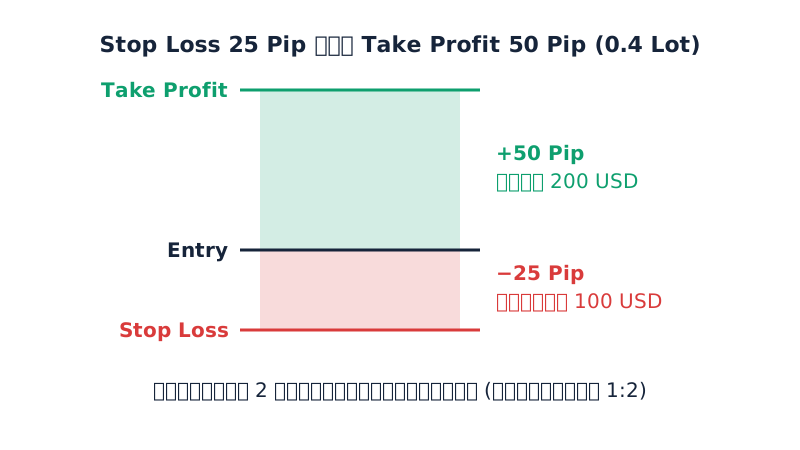
If you set a Take Profit at 50 Pip (2 times the risk, or a 1:2 ratio), the profit if it reaches the target is 0.4 × 50 × 10 = 200 USD.
Why the Risk-to-Reward Ratio Matters
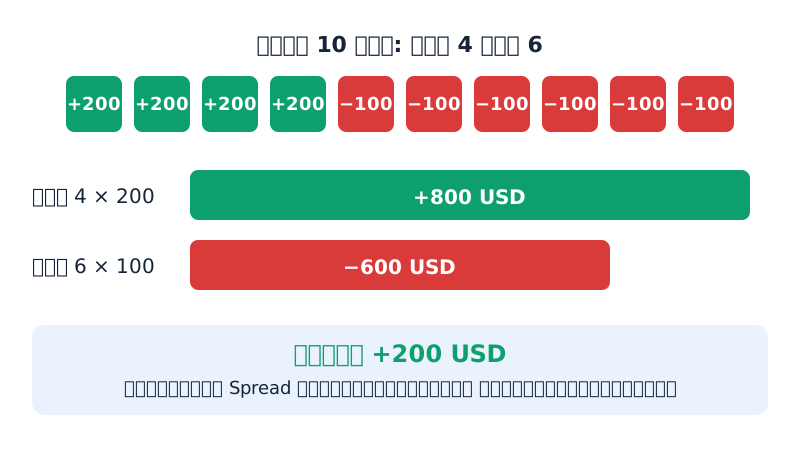
Suppose you take 10 trades, win 4 and lose 6, with each trade following the plan above (not counting Spread or fees):
- Winning trades: 4 × 200 = +800 USD
- Losing trades: 6 × 100 = −600 USD
- Net: +200 USD
This example only shows that you can win less often than you lose and still end up positive if the ratio is right. It does not mean your real results will look like this. Nothing in the market is guaranteed, and trading costs will make real numbers different.
Checklist Before Moving to a Live Account
Don't judge only by your Demo profits. Ask yourself:
- Do I have a clearly written plan, and can I follow it consistently?
- Have I recorded enough trades, and can I see my overall results?
- Do I set a Stop Loss on every trade, and not move it away when the price goes against me?
- Can I calculate my own Lot size based on the risk I set?
- Do I understand costs such as Spread and Swap?
- Is the money I will use spare money, meaning that if I lose it, it won't affect my daily expenses?
If you still answer "no" to many of these, stay on the Demo account longer. There is no deadline to rush.
When You're Ready, Move Gradually
- Start with a small amount that you can truly afford to lose
- Use a small Lot size and the same risk rules you used on Demo
- Follow the same plan. Don't change methods or increase your size just because you feel you've gotten better
- Keep reviewing your records and compare them with your Demo period
Risks and Common Mistakes
- A Demo account has no emotional pressure: Real money brings fear, greed and the urge to win back losses, which a Demo account can't simulate. Your results on a live account may be different.
- Prices and order execution can differ: On a live account you may run into Slippage or fast price moves during news, which a Demo account may not fully reflect.
- Taking unrealistic risk on Demo: Using a large Lot because "the money isn't real" builds habits that you can't use with real money.
- Changing your plan too often: You won't have enough data to judge whether the plan works.
- Rushing to move because Demo profits look great: It may just be a favorable market period or luck over a small number of trades.
- Not setting a Stop Loss, or moving it away: This is a very common cause of big losses.
- Trading with money you need: The pressure makes it easier to make bad decisions.
Trading carries a risk of losing your capital. This article is for educational purposes only and is not investment advice.
Summary
Start with a Demo account to practice the platform and test your plan. Spend about 2–3 months, or until you have enough trade records to evaluate yourself. Write a clear plan that covers entry conditions, exit conditions and risk per trade, then move to a live account with a small amount only when you are truly ready. The key is not to rush for profit, but to build discipline and protect your capital so that you last long enough to keep learning.
Lesson quiz
Score at least 80% to pass this lesson.
According to the article, what is the better way to decide whether you have practiced long enough on a Demo account?
Your Demo account has 5,000 USD. You risk 1% per trade on EURUSD with a Stop Loss of 25 Pip, and 1 Pip per 1 Lot is about 10 USD. What Lot size should you use?
Why does the article say you should keep your Demo balance close to the amount you actually plan to trade with?
In the article's example, a trader wins 4 of 10 trades and loses 6, with a Stop Loss risking 100 USD and a Take Profit gaining 200 USD per trade. What does this example show?
Which of these is a good habit regarding Stop Loss, according to the article?
Ask the AI tutor about this lesson
Stuck on something? Ask and get a simple answer with examples.