What Is a Lot? Standard, Mini and Micro Lots Explained
A Lot is the unit that measures your trade size. Learn how Standard, Mini and Micro Lots differ, with Pip value examples and tips for matching size to your risk.
This article was compiled automatically from the sources listed below
The first time you open a trading platform, you will see a box where you type a number like 1.00, 0.10 or 0.01. These numbers are the Lot, or the size of your trade. If you get it wrong, your profit or loss can be many times bigger than you expected. This article explains it step by step from the basics.
What Is a Lot?
A Lot is the standard unit used to measure trading volume in the forex market. Think of buying eggs sold by the "tray" rather than one at a time. The forex market sets standard sizes so that everyone speaks the same language.
The key rule is 1 Lot = 100,000 units of the first currency in the pair (the Base Currency). For example, if you trade EURUSD at 1 Lot, you are trading 100,000 EUR.
How Do the Lot Sizes Differ?
| Name | Size entered in the platform | Number of units |
|---|---|---|
| Standard Lot | 1.00 Lot | 100,000 units |
| Mini Lot | 0.10 Lot | 10,000 units |
| Micro Lot | 0.01 Lot | 1,000 units |
A bigger size means every 1 Pip the price moves changes your profit or loss by a larger amount. It does not mean better or worse. It is simply a tool for adjusting your level of risk.
Note: Some brokers offer sizes smaller than 0.01 Lot or set different minimums. Always check the Contract Specification in your platform before trading with real money.
Pip Value by Lot Size
A Pip is a unit for measuring price movement. In most currency pairs, 1 Pip equals 0.0001 (pairs with JPY are usually 0.01).
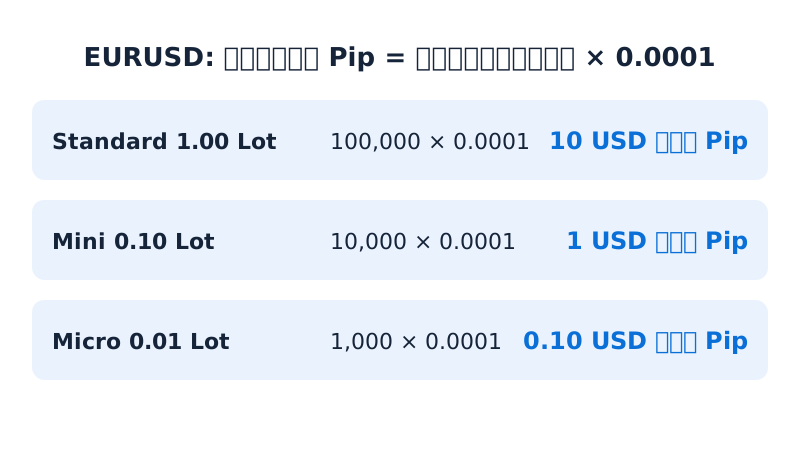
For EURUSD, where the second currency is USD, you can calculate the Pip value like this:
Pip value = number of units × 0.0001
- Standard (100,000 units): 100,000 × 0.0001 = 10 USD per Pip
- Mini (10,000 units): 10,000 × 0.0001 = 1 USD per Pip
- Micro (1,000 units): 1,000 × 0.0001 = 0.10 USD per Pip
The Pip value of other pairs may be different, because it depends on the second currency of that pair and the exchange rate. Most platforms have a calculator you can use.
Comparison Example: A 25 Pip Move
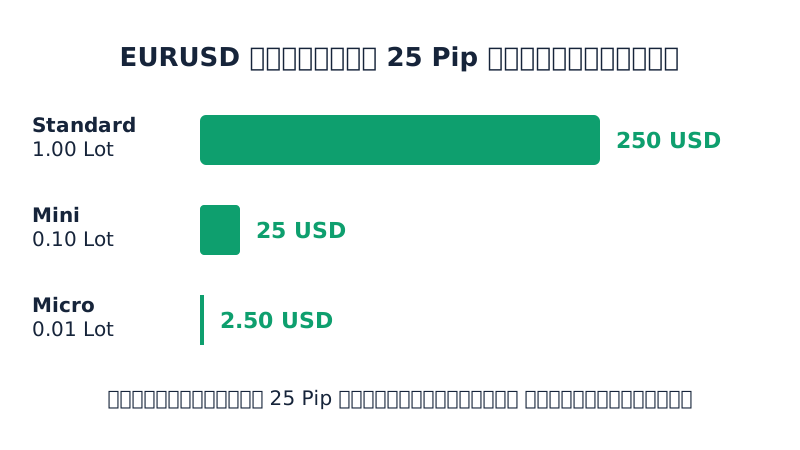
Say you trade EURUSD and the price moves 25 Pips in the direction you expected. The results by Lot size are:
- Standard 1.00 Lot: 25 × 10 = 250 USD
- Mini 0.10 Lot: 25 × 1 = 25 USD
- Micro 0.01 Lot: 25 × 0.10 = 2.50 USD
If the price moves 25 Pips against you, the loss is the same amount, only negative. The same size that magnifies your profit can magnify your loss just as much.
Example: Calculating Lot Size from the Risk You Can Accept
Instead of picking a Lot by feel, many traders start with the question: "How much am I willing to lose on this trade?"
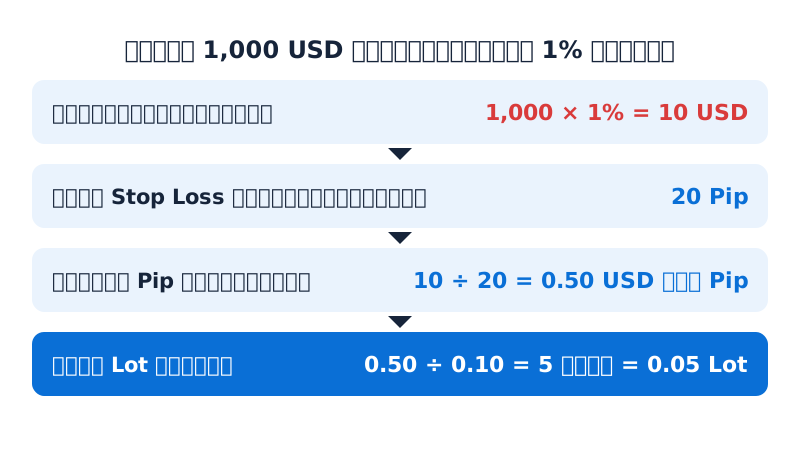
Suppose your account has 1,000 USD and you decide to risk no more than 1% per trade (this number is only an example for the calculation).
- Amount you can afford to lose = 1,000 × 1% = 10 USD
- Set your Stop Loss 20 Pips away from your entry price
- Suitable Pip value = 10 ÷ 20 = 0.50 USD per Pip
- A Micro Lot (0.01) is worth 0.10 USD per Pip, so you need 0.50 ÷ 0.10 = 5 times that, which is 0.05 Lot
Check: 0.05 Lot is worth 0.50 USD per Pip. If your Stop Loss is hit at 20 Pips, you lose 20 × 0.50 = 10 USD, which matches what you planned.
Lot, Margin and Leverage
Opening a trade requires a deposit called Margin, which depends on the Lot size and the Leverage. In this example, assume EURUSD is at 1.1000 and Leverage is 1:100.
- Trading 0.01 Lot = 1,000 EUR, worth 1,000 × 1.1000 = 1,100 USD
- Margin required = 1,100 ÷ 100 = 11 USD
If you increase to 0.10 Lot, the Margin rises to 110 USD, and at 1.00 Lot it is 1,100 USD. So Lot size affects both your profit and loss and the capital you must set aside.
Does Gold (XAUUSD) Use Lots the Same Way?
The idea is the same, but the contract size for gold is not as fixed as it is for currency pairs. Each broker may define 1 Lot as a different number of ounces, so the value per price move differs too. Always check the XAUUSD contract specification in the platform you use, and never assume the EURUSD numbers apply.
Why Beginners Should Start with Micro Lots
Starting with Micro Lots makes mistakes cheaper. The main reasons are:
- You can learn the system at low risk, such as placing orders, closing trades and reading your profit and loss.
- It is easier to control your emotions. When the amount you could lose is small, you can stick to your plan better.
- You can survive more mistakes. Even several losses in a row will not hurt your capital much.
Once you have experience and a clear risk management plan, you can consider increasing your size step by step. The right size depends on each person's capital and risk tolerance.
Risks and Common Mistakes
- Mixing up the units. Typing 1.00 instead of 0.01 makes your trade 100 times bigger by accident. Check the Lot box every time before you confirm.
- Using a Lot that is too big for your capital. With a small account and a large trade, even a small price move can force your trade to close (Margin Call or Stop Out).
- Not setting a Stop Loss. This can lead to losses bigger than you intended, especially with a large Lot.
- Increasing Lot size to win money back. Raising your size right after a loss greatly increases your risk.
- Assuming the Pip value is the same for every pair. Check the real value for each asset before trading.
Trading forex and gold is high risk, and you could lose all of your capital. This content is for education only. It is not advice to buy or sell, nor a guarantee of returns.
Summary
- A Lot is the unit that measures trade size. 1 Lot = 100,000 units of the first currency in the pair.
- Standard = 1.00 Lot, Mini = 0.10 Lot, Micro = 0.01 Lot.
- In EURUSD, the Pip values are 10, 1 and 0.10 USD respectively.
- Choose your Lot size based on the amount you can afford to lose and your Stop Loss distance, not on feeling.
- Beginners should start with Micro Lots to practice more safely, and always check the contract specification of each asset.
Lesson quiz
Score at least 80% to pass this lesson.
You trade 0.10 Lot of EURUSD. How many units of the Base Currency are you trading?
You trade 0.01 Lot of EURUSD and the price moves 40 Pips in your favor. Using the article's Pip values, what is your profit?
What does choosing a bigger Lot size actually do?
Your account has 2,000 USD, you risk 1% per trade, and your Stop Loss is 20 Pips away. Using EURUSD values from the article, which Lot size matches this plan?
You are about to trade gold (XAUUSD) and you assume it works exactly like EURUSD, with 1 Lot = 100,000 units. According to the article, what is the problem?
Ask the AI tutor about this lesson
Stuck on something? Ask and get a simple answer with examples.