Trading Psychology and Trade Journals: Control Emotions, Track Stats
Learn the emotions that trip up new traders: FOMO, greed and revenge trading. Plus how to set a daily stop rule and keep a trading journal step by step.
This article was compiled automatically from the sources listed below

Many people think surviving as a trader depends on finding the most accurate entry point. But a lot of traders lose money because they "don't follow the plan they made" rather than because they have no plan. And the root cause of not following the plan is usually emotion.
This article looks at 3 common emotions, how to set a daily stop-trading rule, and how to keep a trading journal that shows your own behavior based on real data.
3 Emotions That Often Cause Mistakes
1) Fear of Missing Out (FOMO)
FOMO is the feeling that "if I don't get in right now, I'll miss the opportunity." It usually happens when you see the price already moving fast, so you jump in without a clear Stop Loss, or use a bigger Lot than usual to "make up for being late."
Warning signs:
- You open a trade that doesn't match the conditions in your plan
- You open the chart and feel an urgent need to do something
- You can't answer where you would place your Stop Loss
The market is open for trading every day, and new opportunities keep appearing. Letting one opportunity go doesn't damage your account, but entering without a plan can.
2) Greed
Greed often shows up as refusing to close a profit as planned, moving your Take Profit further and further away, or increasing your Lot after a winning streak because you feel "I'm on a roll today." The result is that profits you once had disappear, or a single loss that is too big wipes out several wins.
3) Revenge Trading
After a loss, you feel you "have to get it back," so you rush to open a new trade right away, often with a larger Lot. This kind of trading is driven by anger and the urge to win the money back, not by a signal from your plan. It can easily lead to repeated losses that are deeper than before.
Daily Stop-Trading Rule: A Brake You Set Before the Emotions Arrive
We make poor decisions when emotions run high, so a rule written in advance while you're calm helps a lot. There are 3 popular types of rules:
- Maximum loss per day, for example no more than 3% of your account
- Number of consecutive losing trades, for example stop after 3 losses in a row
- Maximum number of orders per day, for example no more than 5 orders
Calculation Example
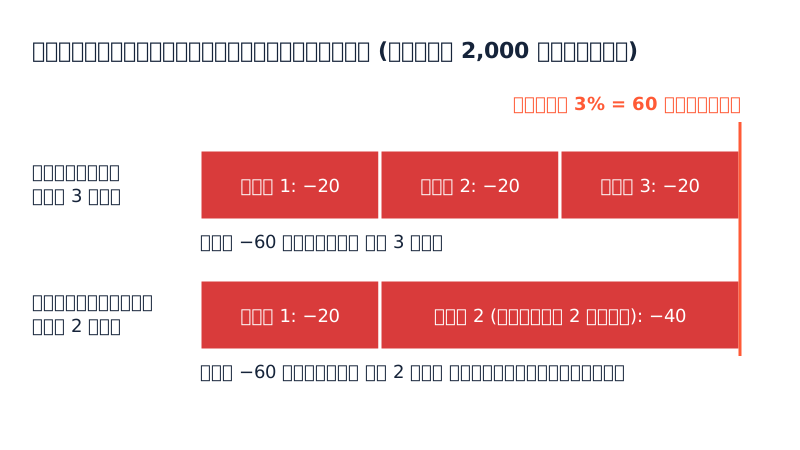
Suppose you have a $2,000 account and set your risk per trade at 1% of the account.
- Risk per trade = 2,000 × 1% = $20
- Maximum daily loss of 3% = 2,000 × 3% = $60
- If you lose the full $20 on each trade, 3 losses = $60, which hits the limit exactly
When you reach the limit, close your trading platform and rest until the next day. The key point is never change the rule in the middle of the day. If you want to adjust it, review it at the end of the week.
Compare this with revenge trading: after losing $20, if you double your risk to $40 to "get it back" and lose again, your total loss is $60. You hit the daily limit in 2 trades instead of 3. Increasing your size after a loss makes your account suffer damage faster.
What to Record in a Trading Journal
A trading journal can be a real notebook, Excel or Google Sheets. What matters is that you record every trade, not just the winning ones. The information to record:
Order information
- Date and time of entry and exit
- The instrument traded, such as EURUSD or XAUUSD
- Direction (Buy or Sell)
- Entry price, Stop Loss, Take Profit
- Lot size and the amount of money you were willing to risk
- Result in money or in R (risk units)
Behavioral information
- Reason for entry, and whether it matched your plan
- Your emotions before entering and after exiting (calm, afraid, anxious, angry)
- Whether you followed all your rules (yes/no)
- A screenshot of the chart at entry
- A short 1-line lesson
The "followed all rules" and "emotions" columns often give the most useful information, because they show whether the problem is in your strategy or in your discipline.
Stats to Look at in Your Journal
- Win Rate = number of winning trades ÷ total number of trades
- Average profit per winning trade and average loss per losing trade
- Profit-to-loss ratio = average profit ÷ average loss
- Expectancy = the average result you can expect per trade
- Max Drawdown = the largest drop in your account balance from its peak
- Longest losing streak, which helps you prepare mentally for how long bad periods might last
- Rule-following rate, for example following the rules on 18 out of 20 trades = 90%
Example of Reading the Stats
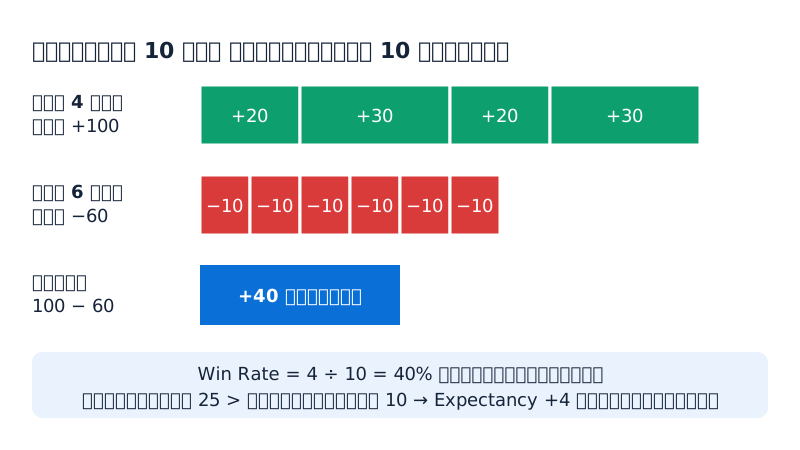
Suppose you make 10 trades, with a risk of $10 per trade.
- 4 winning trades: +20, +30, +20, +30 = +$100
- 6 losing trades: −10 each = −$60
- Total = 100 − 60 = +$40
Calculating the stats:
- Win Rate = 4 ÷ 10 = 40%
- Average profit = 100 ÷ 4 = $25
- Average loss = 60 ÷ 6 = $10
- Profit-to-loss ratio = 25 ÷ 10 = 2.5
- Expectancy = (0.4 × 25) − (0.6 × 10) = 10 − 6 = +$4 per trade, which matches 40 ÷ 10 trades
This example shows that a Win Rate below 50% can still produce a positive total if the average profit is large enough compared with the average loss. But these numbers are only an example for learning and do not guarantee future results.
Risks and Common Mistakes
- Drawing conclusions from too little data. 10 trades is very few. Collect dozens to hundreds of trades before drawing any serious conclusions.
- Recording only winning trades, or secretly editing the numbers. This distorts your stats and hides your problems.
- Having rules but not following them. A stop-trading rule is useless if you cancel it every time you feel "this trade is a sure thing."
- Changing strategy every time you lose, until no set of data is large enough to evaluate.
- Trading when you're not emotionally ready, such as when you're short on sleep, stressed about money, or just had an argument.
- Using money you need for living expenses. The more pressure you feel about money, the harder it is to control your emotions.
Trading always carries the risk of losing your capital. No method of managing your mind or your stats can guarantee a profit.
Getting Started Simply
- Write 3–5 personal rules: risk per trade, maximum daily loss, maximum number of orders
- Create a simple journal table based on the sections above
- Record every trade on the same day, while your memory is still clear
- Review once a week, looking at both the numbers and the emotions column
- Adjust one thing at a time, and watch the results over several weeks before making the next adjustment
In short, trading psychology can be trained with clear rules and data from your own journal. When you see your own behavior in numbers, your decisions become more data-driven and less emotional.
This article is educational content and is not investment advice.
Lesson quiz
Score at least 80% to pass this lesson.
According to the article, what is usually the root cause of traders not following the plan they made?
After a loss, a trader rushes into a new trade with a bigger Lot to "get the money back," even though no signal from the plan appeared. Which emotion-driven mistake is this?
You have a $2,000 account, risk 1% per trade, and set a maximum daily loss of 3%. After losing $20 on the first trade, you double your risk to $40 on the second trade and lose again. What is the situation?
A trader makes 10 trades risking $10 each: 4 winners totaling +$100 and 6 losers totaling −$60. Which conclusion matches the article?
Why does the article say the "followed all rules" and "emotions" columns in a trading journal are often the most useful?
Ask the AI tutor about this lesson
Stuck on something? Ask and get a simple answer with examples.