How Much to Risk Per Trade? The 1–2% Rule and Lot Size Formula
Learn the 1–2% risk rule per trade and the formula to calculate Lot size from the amount you accept losing and your Stop Loss, with a $1,000 account example.
This article was compiled automatically from the sources listed below
Many beginners ask, "How many Lots should I open?" But a better question is, "If this trade goes wrong, how many dollars am I willing to lose?" Once you can answer that, the Lot size follows from a simple calculation. This article explains the 1–2% rule, the formula, and what happens when you lose several trades in a row.
What Is the 1–2% Rule?
The 1–2% rule is a risk management guideline that says on each trade, you should not accept losing more than 1–2% of your total capital if the trade hits your Stop Loss.
This number is not a fixed law or a formula that guarantees profit. It is a framework that helps you survive long enough to learn. For example, with $1,000 of capital:
- Risking 1% = a maximum loss of $10 per trade
- Risking 2% = a maximum loss of $20 per trade
The key point is that this "amount you accept losing" is the money you lose when price reaches your Stop Loss. It is not the amount of money used to open the trade (Margin).
The Lot Size Formula
The formula is:
Lot = amount you accept losing ÷ (SL pips × pip value per 1 Lot)
Here is what each part means:
- Amount you accept losing: capital × risk percentage
- SL pips: the distance from your entry to your Stop Loss, counted in Pips
- Pip value per 1 Lot: how much money changes per 1 Pip when you trade 1 standard Lot
For pairs where USD is the second currency, such as EURUSD, the pip value of 1 standard Lot is about $10. For other pairs or other assets such as XAUUSD, the pip value and even the definition of a pip may differ depending on each platform's contract specification. So always check the Contract Specification before you calculate.
Example 1: $1,000 Capital, Risking 1%
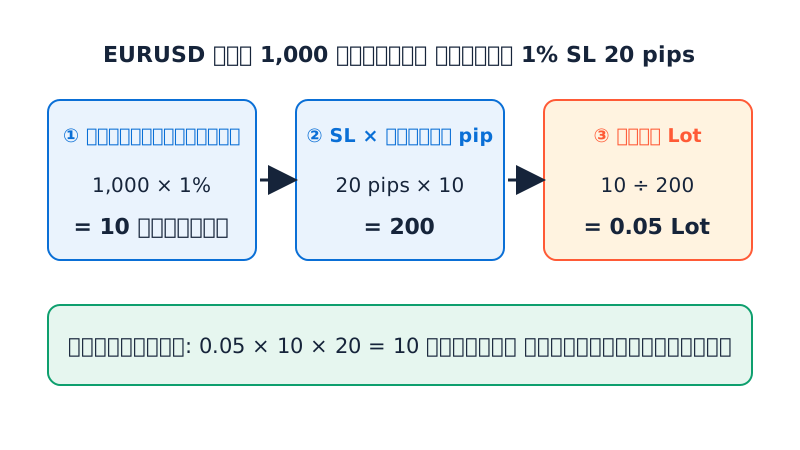
Suppose you trade EURUSD and set your Stop Loss 20 pips from your entry.
- Amount you accept losing = 1,000 × 1% = $10
- Pip value per 1 Lot ≈ $10
- Lot = 10 ÷ (20 × 10) = 10 ÷ 200 = 0.05 Lot
Check: 0.05 Lot × $10 × 20 pips = $10, which matches the amount you accept losing.
Example 2: Risking 2% with a Wider SL
Same capital, but you risk 2% and your Stop Loss is 50 pips away.
- Amount you accept losing = 1,000 × 2% = $20
- Lot = 20 ÷ (50 × 10) = 20 ÷ 500 = 0.04 Lot
Check: 0.04 × 10 × 50 = $20
Notice that when the SL gets wider, the Lot must get smaller. Each pip that moves against you has to be worth less so the total loss stays within your target. This is the heart of Lot calculation: set your Stop Loss based on the market situation, then adjust your Lot to fit the Stop Loss. Do not adjust your Stop Loss to fit the Lot you want to open.
What If the Calculated Lot Doesn't Fit?
If your Stop Loss is very wide, the result may be smaller than the minimum Lot your platform allows. For example, with $1,000 capital, 1% risk ($10), and a 150-pip SL:
- Lot = 10 ÷ (150 × 10) = 10 ÷ 1,500 ≈ 0.0067 Lot
This is below 0.01 Lot. If you force a 0.01 Lot trade, your loss would be 0.01 × 10 × 150 = $15, or 1.5% of your capital, more than you intended. Your options are to skip that trade, or to knowingly accept the higher risk. Also, always round your Lot down, never up.
What Happens After Several Losses in a Row?
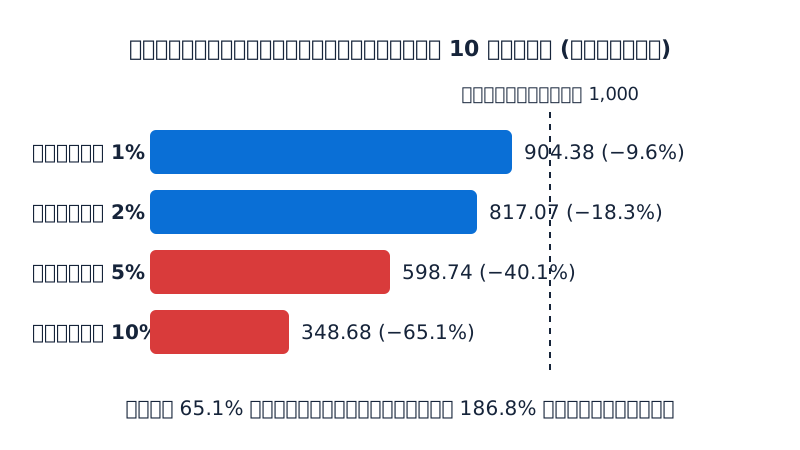
Even with a good plan, losing streaks can happen, because no trading system wins every time. Let's see how much is left from $1,000 after 10 losses in a row, losing the same percentage of the latest balance each time (rounded to 2 decimal places).
| Risk per trade | Balance after 10 losses in a row | Approximate total loss |
|---|---|---|
| 1% | $904.38 | 9.6% |
| 2% | $817.07 | 18.3% |
| 5% | $598.74 | 40.1% |
| 10% | $348.68 | 65.1% |
At 1–2%, the account is hurt but still in a recoverable range. At 5–10%, just a few losses cut very deep.
The reason deep losses are hard to recover from is that getting back to your starting capital takes a higher return than the percentage you lost.
- After losing 18.3% (the 2% case), you need a gain of about 22.4% to break even.
- After losing 40.1% (the 5% case), you need about 67.0%.
- After losing 65.1% (the 10% case), you need about 186.8%.
This is why keeping the risk per trade small matters more than trying to find a trade that "must win."
Risks and Common Mistakes
- Increasing your Lot to win it back after a loss. This quickly turns a losing streak into a deep hole.
- Not setting a Stop Loss. The formula can't be used because there is no SL distance to calculate with, and your loss has no ceiling.
- Moving your Stop Loss further away when price gets close to it. This makes your real risk larger than planned.
- Forgetting the spread, commission and Slippage. During strong news or fast markets, your exit price can be worse than your SL, so the real loss may be larger than calculated.
- Opening several trades at once in pairs that move in the same direction, such as several pairs that share USD. Your total risk may be higher than you think.
- Using the wrong pip value, especially with pairs where USD is not the second currency, or with gold. Check the contract specification first.
- Thinking 1–2% guarantees results. This rule only limits the loss on each trade. It does not mean you will always profit.
A Step-by-Step Summary You Can Use Every Time
- Choose your risk percentage (for example, 1%) and multiply it by your capital to get the amount you accept losing.
- Place your Stop Loss based on the price situation, then count the distance in pips.
- Find the pip value per 1 Lot for the asset you are trading.
- Calculate Lot = amount you accept losing ÷ (SL pips × pip value), then round down.
- If the Lot is below the minimum, consider skipping the trade instead of increasing your risk.
Practice the calculation on a demo account until it feels easy. Risk control is a skill you need to repeat until it becomes a habit, and every type of trading always carries the risk of losing your capital.
Lesson quiz
Score at least 80% to pass this lesson.
According to the article, what does the "amount you accept losing" in the Lot formula represent?
You have $2,000 of capital and risk 1% on a EURUSD trade (pip value about $10 per 1 Lot). Your Stop Loss is 25 pips from entry. What Lot size does the formula give?
Your calculation gives 0.04 Lot, but you would like to trade 0.10 Lot. What does the article recommend?
With $1,000 capital, 1% risk and a 150-pip SL, the formula gives about 0.0067 Lot, but the platform minimum is 0.01 Lot. What happens if you force a 0.01 Lot trade on EURUSD?
Why does the article say deep losses are hard to recover from?
Ask the AI tutor about this lesson
Stuck on something? Ask and get a simple answer with examples.