What Are Margin, Free Margin and Margin Call? A $500 Account Example
Understand Margin, Equity, Free Margin, Margin Level, Margin Call and Stop Out through a $500 account example, so you can manage risk better.
This article was compiled automatically from the sources listed below
When you open a trade in the forex or gold market, you will see several numbers on your account page, such as Balance, Equity, Margin and Free Margin. If you don't understand these numbers, your trades could be closed automatically before you know what's happening.
This article explains each term one by one, with a worked example based on a $500 account.
What Is Margin?
Margin is part of the money in your account that the system "sets aside" as a deposit when you open a trade. It is not a fee, and it doesn't disappear. When you close the trade, this money is released back to you (profit or loss is calculated separately).
The general formula for currency pairs:
Margin = (Lot size × contract size × price) ÷ Leverage
For example, with EURUSD the standard contract size is 100,000 units per 1 Lot, so 0.10 Lot equals 10,000 EUR.
Key Terms You Need to Know
- Balance is the amount of money in your account, not including the profit or loss on trades that are still open.
- Equity is Balance plus or minus the floating profit or loss on open trades. It is the true value of your account at that moment.
- Margin (Used Margin) is the money set aside for your open trades.
- Free Margin is Equity minus Margin. It is the money left over for opening new trades, and it also absorbs floating losses.
- Margin Level is (Equity ÷ Margin) × 100, shown as a percentage. The higher it is, the safer your account.
- Margin Call is a warning that appears when Margin Level falls to a set level.
- Stop Out is the level at which the system starts closing your trades automatically, so your account doesn't go further into negative territory.
Margin Call and Stop Out levels differ from broker to broker, so read the terms of the account you use. The example below assumes a Margin Call at 100% and a Stop Out at 50%.
$500 Account Example
Assumptions
- Balance of $500
- Leverage of 1:100
- A Buy EURUSD trade of 0.10 Lot opened at a price of 1.1000
- To keep things simple, assume Margin stays constant and 1 Pip on 0.10 Lot is worth about $1
Step 1: Calculate the Margin
Contract value = 10,000 × 1.1000 = $11,000
Margin = 11,000 ÷ 100 = $110
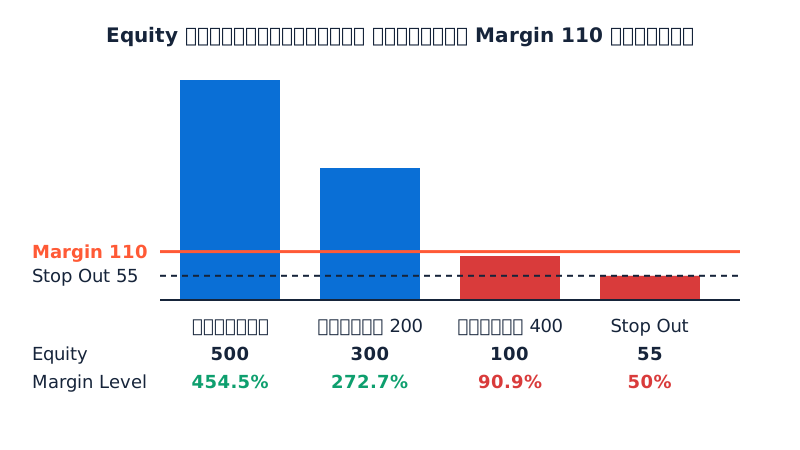
Step 2: Right after opening the trade (no profit or loss yet)
- Equity = 500
- Free Margin = 500 − 110 = 390
- Margin Level = (500 ÷ 110) × 100 ≈ 454.5%
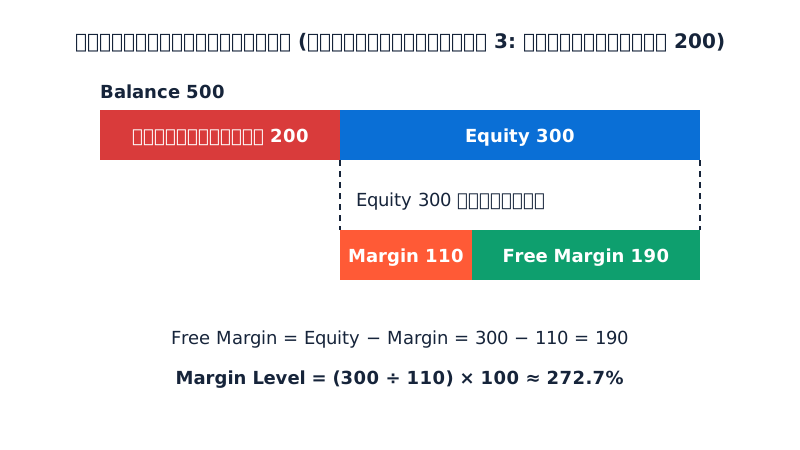
Step 3: Price moves against you, floating loss of $200
- Equity = 500 − 200 = 300
- Free Margin = 300 − 110 = 190
- Margin Level = (300 ÷ 110) × 100 ≈ 272.7%
Step 4: Floating loss of $400
- Equity = 500 − 400 = 100
- Free Margin = 100 − 110 = −10
- Margin Level = (100 ÷ 110) × 100 ≈ 90.9%
Now Free Margin is negative, so you can't open new trades, and Margin Level is below 100%, which puts you in Margin Call territory under our assumptions.
Step 5: The Stop Out point
A Stop Out at 50% means Equity equals half of the Margin, which is 110 × 0.5 = $55
At that point the floating loss is 500 − 55 = $445, or about 445 Pips in this example. The system starts closing your trades automatically. The money left in your account is about $55.
On a $500 account, just one 0.10 Lot trade already sets aside more than 20% of your money and leaves very little room to absorb price swings.
Comparing with a Smaller Lot Size
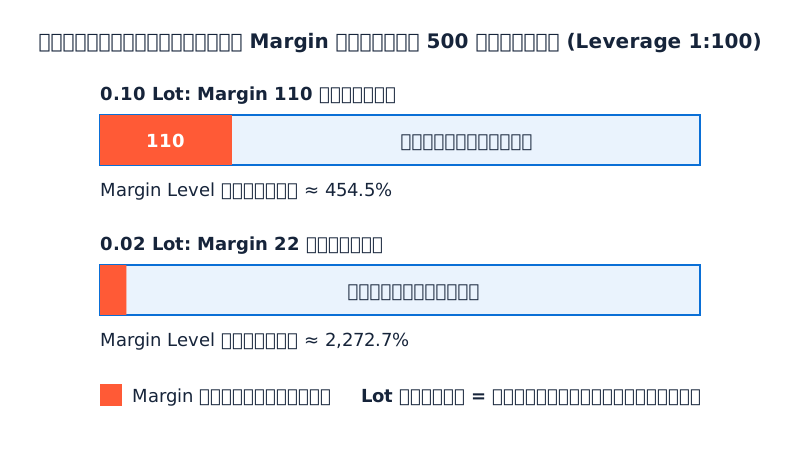
If you open only 0.02 Lot at the same price:
- Contract value = 2,000 × 1.1000 = $2,200
- Margin = 2,200 ÷ 100 = $22
- Margin Level when opened = (500 ÷ 22) × 100 ≈ 2,272.7%
The Pip value for 0.02 Lot is about $0.20. Price has to move against you much further before the account enters the danger zone. The key point is that a smaller Lot size gives you more breathing room, even though Leverage hasn't changed at all.
Risks and Common Mistakes
- Thinking low Margin means low risk. Margin only tells you how much money is set aside. Profit and loss depend on your Lot size and how far price moves.
- Using high Leverage and opening the biggest Lot you can. This leaves very little Free Margin, so a small move against you can trigger a Margin Call.
- Not setting a Stop Loss and letting the Stop Out close your trades instead. This is often a deeper loss than you planned for.
- Averaging down by opening more trades. This increases the Margin used and makes Margin Level fall faster than before.
- Looking only at Balance. You should watch Equity and Margin Level, because Balance doesn't reflect floating losses.
- Not knowing your own account's Margin Call and Stop Out levels. Each account sets them differently.
- Forgetting that price can jump past a level. During major news, for example, trades may be closed at a worse price than expected, and in some cases you could lose more than you thought. Find out whether your account has negative balance protection.
Basic Risk Management Tips
- Calculate the Margin and check the Margin Level before you open every trade.
- Decide how much risk per trade, as a percentage of Equity, you are comfortable with, then choose your Lot size based on the Stop Loss distance.
- Always keep some Free Margin in reserve. Don't use it almost all up.
- Practice on a Demo account to see how these numbers change as price moves.
Summary
Margin is the money set aside as a deposit. Equity is the true value of your account. Free Margin is the money you have left to use. Margin Level measures how far your account is from the danger zone. When Margin Level falls to the Margin Call level, you get a warning, and if it falls to the Stop Out level, the system closes your trades.
Understanding these numbers helps you choose a Lot size that suits your capital, but it does not guarantee profit. Trading carries the risk of losing your capital. Only use money you can afford to lose.
Lesson quiz
Score at least 80% to pass this lesson.
A beginner says, "Margin is a fee the broker charges me every time I open a trade." According to the article, what is Margin really?
An account has a Balance of $500 and one open trade that uses $110 of Margin. The trade currently has a floating loss of $150. What is the Free Margin?
Why does opening 0.02 Lot instead of 0.10 Lot give a $500 account more breathing room, even though Leverage stays at 1:100?
Using the article's formula, how much Margin is needed to open a Buy EURUSD trade of 0.05 Lot at a price of 1.1000 with Leverage of 1:100? (1 Lot = 100,000 units)
Why does the article advise watching Equity and Margin Level instead of looking only at Balance?
Ask the AI tutor about this lesson
Stuck on something? Ask and get a simple answer with examples.