Trading Risks Every Beginner Should Know and How to Manage Them
Learn the main risks of trading Forex, gold and stocks, with an example of how to calculate Lot size from the amount you can afford to lose on each trade.
This article was compiled automatically from the sources listed below
People who are new to trading usually ask first, "How much can I make?" But the more important question is, "If I'm wrong, how much could I lose?" There is no way to remove risk from trading completely. What you can do is understand where risk comes from and set limits on your possible losses in advance.
This article covers basic knowledge only. It is not advice to buy or sell any asset.
The Main Risks in Trading
1) Price Movement Risk (Market Risk)
The prices of EURUSD, XAUUSD or a stock can rise and fall at any time, and no one knows for sure which way they will go. Even a well-researched analysis can be wrong. So always keep in mind that every trade has a chance of losing money.
2) Leverage Risk
Leverage lets you open a position larger than the money in your account. The upside is that you need less capital. The downside is that profits and losses are magnified equally.
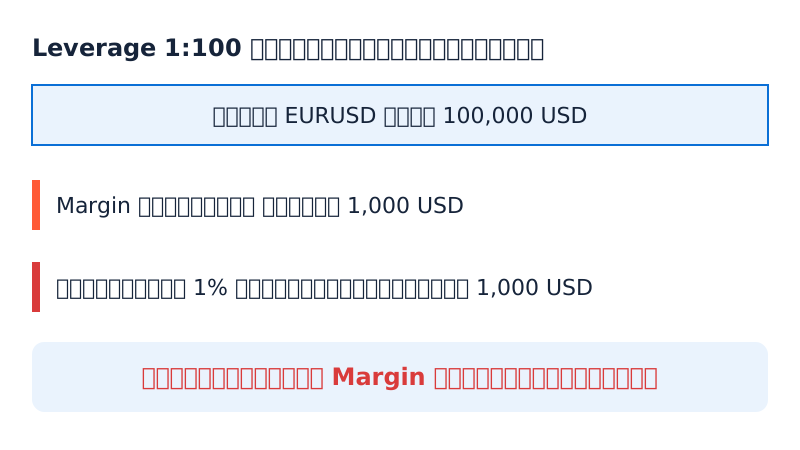
Example (hypothetical): Using Leverage of 1:100 to open a EURUSD position of 100,000 USD requires about 1,000 USD of Margin. If the price moves just 1% in the wrong direction, the value of the position changes by 1,000 USD, which equals the entire Margin you put up. A move that looks small can cause a big loss.
3) News and Price Jump Risk (Gap and Slippage)
During major news or very volatile periods, prices can move so fast that your order is filled at a different price from the one you set (Slippage), or the market opens past the price where you placed your Stop Loss (Gap). This can make your loss bigger than you planned.
4) Emotional Risk
Greed and fear are behind many bad decisions. Examples include revenge trading after a loss, increasing Lot size to win the money back quickly, or holding a losing position in the hope that the price will come back.
5) Currency Exchange and Broker Risk
If your trading account is in US dollars but your income and expenses are in baht or kip, changes in exchange rates when you deposit and withdraw can affect your real results. You should also always check that the provider you use is trustworthy, has clear deposit and withdrawal terms, and is not a service that tempts people to invest by guaranteeing returns.
Example: Setting Risk per Trade as a Percentage
A basic method many people use is to decide first what percentage of your capital you are willing to lose on one trade, then work backward to calculate the Lot size.
Assume:
- Account capital is 5,000 USD
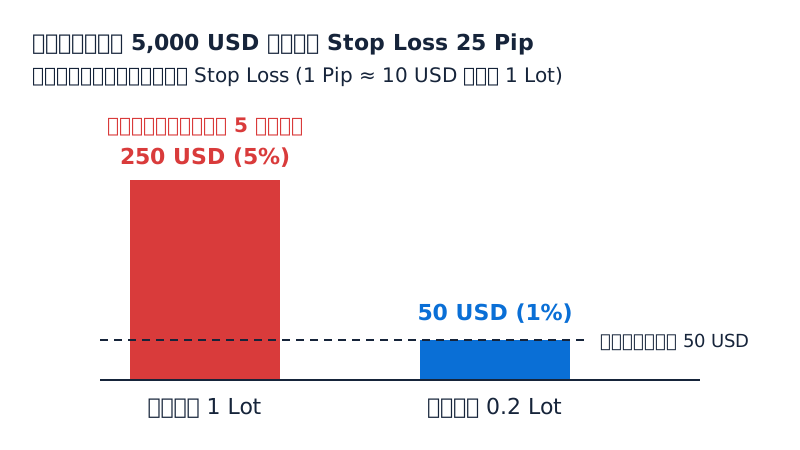
- You are willing to lose 1% per trade = 50 USD
- You trade EURUSD with a Stop Loss 25 Pip from your entry point
- The Pip value of EURUSD is about 10 USD per 1 Lot (the actual value may differ slightly depending on the account and provider)
Calculation steps:
- If you open 1 Lot and it hits the Stop Loss, you lose 25 × 10 = 250 USD
- The amount you are willing to lose is 50 USD
- The right Lot size = 50 ÷ 250 = 0.2 Lot
- Check: 0.2 × 10 × 25 = 50 USD, which matches the plan
If you opened 1 Lot with the same Stop Loss, you would lose 250 USD, or 5% of your account in a single trade. That is 5 times more than planned.
Why Risk Only a Little per Trade
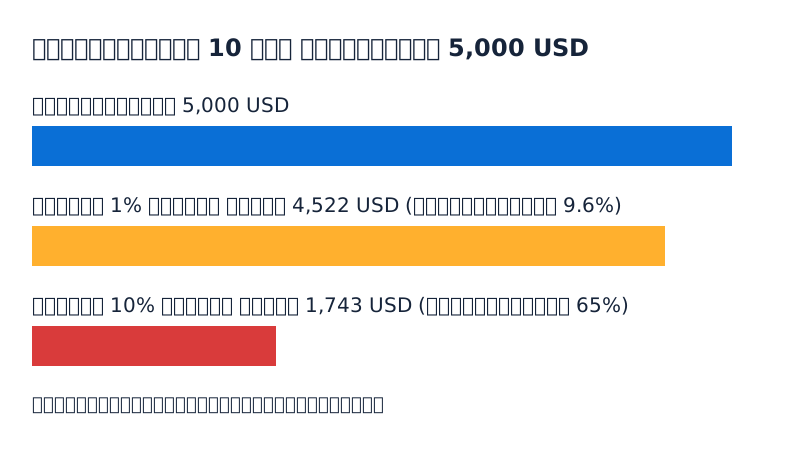
Losing streaks can happen to anyone. Let's compare 10 losses in a row from 5,000 USD of capital:
| Risk per trade | Approximate remaining balance | Approximate total loss |
|---|---|---|
| 1% | 4,522 USD | About 9.6% |
| 10% | 1,743 USD | About 65% |
(Calculated with the balance shrinking proportionally on each trade, for example 5,000 × 0.99 to the power of 10)
Another thing to know is that recovering lost money takes a bigger gain than the amount you lost.
- After a 20% loss, you need a 25% gain on the remaining money to get back to even (1 ÷ 0.8 = 1.25)
- After a 50% loss, you need a 100% gain to get back to even
The deeper the loss, the harder the road back. So limiting your losses from the start matters more than trying to win the money back.
Basic Risk Management Tools
- Stop Loss: An order that closes your position when the price reaches the point where you accept a loss. It should be set based on price structure and your plan, not based on the amount of money you want to lose.
- Setting Lot size: Calculate it from the amount you are willing to lose and the Stop Loss distance, as in the example above.
- Limit the number of open positions: Several positions moving in the same direction, such as multiple currency pairs that share USD, may amount to taking the same risk twice.
- Check your Margin level: Keep enough spare money in the account so you are not at risk of a Margin Call or having your positions closed automatically.
- Try a demo account first: Practice planning and calculating risk without using real money.
Common Mistakes
- Using maximum Leverage because you want quick profits
- Not setting a Stop Loss, or moving the Stop Loss away when the price gets close to it
- Increasing Lot size after a loss to win the money back
- Trading with money you need for daily life, such as rent or food
- Not preparing for major news announcements, when prices can be volatile and Slippage can happen
- Believing ads that say "sure win" or "guaranteed returns," which do not exist in a market where prices move unpredictably
Summary
Risk is an unavoidable part of trading, but it can be controlled to a certain extent. Start by learning about each type of risk, set the percentage you are willing to lose per trade, calculate Lot size from your Stop Loss, and use only spare money that won't affect your life if you lose it. When you have a clear framework, losses become something you can handle, not something that wipes out your whole account.
Before using real money, always practice in a demo account and make sure you understand the conditions of the asset you plan to trade.
Lesson quiz
Score at least 80% to pass this lesson.
You open a 50,000 USD EURUSD position using Leverage of 1:100. About how much Margin is needed, and what happens if the price moves 1% against you?
Your account has 2,000 USD. You are willing to lose 1% per trade and place a Stop Loss 20 Pip from entry on EURUSD (Pip value about 10 USD per 1 Lot). What Lot size matches your plan?
What does it mean when a Gap happens around your Stop Loss?
Your account falls by 50%. According to the article, what gain on the remaining money do you need to get back to even?
How does the article say a Stop Loss should be set?
Ask the AI tutor about this lesson
Stuck on something? Ask and get a simple answer with examples.